
- News
- City News
- chandigarh News
- Madhuri, Punjabi abuses & honour at heights of Kargil War
Trending
This story is from June 27, 2019
Madhuri, Punjabi abuses & honour at heights of Kargil War
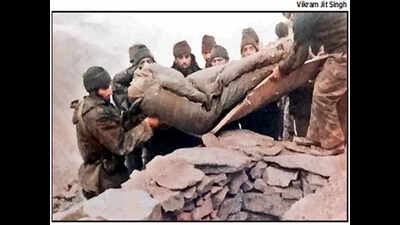
A dead soldier of Pakistan Army's 8 NLI is lowered into an improvised grave by soldiers of the 12 JAK Light Infantry at Point 4812 (15,879 feet), Khalubar Ridge, Batalik, during the Kargil War
A Pakistani soldier of the 12 Northern Light Infantry (NLI) suddenly shouted at troops of the 13 JAK Rifles, who had encircled his bunker: "Why do you fire so many bullets at us, Saathiyo? Don't fire at us, we will go back, but just give us Madhuri Dixit as a return gift!"
It was not Madhuri but a bullet between the eyes that the Pakistani soldier got as a swift gift a few minutes later. Soldiers would later recount they emptied the full magazine of abuses acquired over a lifetime in those intense battle moments when comrades lay wounded and dead beside them. "Abuses were hurled between us and they acted as a kind of psychological operations against the adversary. But I recollect, during a brief lull in firing, it turned quite funny. A Pakistani soldier asked us to stop firing and requested we give him Madhuri Dixit and he will go back to his side of the LOC. It got me thinking, that this fellow has just a few seconds to live and yet his humour has not deserted him," Brig S Vijay Bhaskar, Vir Chakra, told TOI.
During the 1999 Kargil War, Bhaskar was a Major commanding Alpha company with the highly-decorated 13 JAK Rifles immortalized by the Param Vir Chakra awardee of 'Yeh Dil Maange More' fame, Capt Vikram Batra.
On the north-eastern flank of the Kargil War, soldiers of the 12 JAK LI were waging a very tough battle in the Batalik sector. The battalion was to later receive the rare distinction of Battle and Theatre Honours for the War. The troops had entered into a vivid verbal exchange with Pakistani troops of the 8 NLI entrenched in the Point 4812 complex on the Khalubar ridge. Fresh from that battle, 12 JAK LI soldiers had recounted the exchanges to this correspondent when he spent the night with them on Khalubar ridge during the Kargil War amid intense small arms fire from NLI still entrenched on the flanking Kukarthang ridge and shelling from Pakistani mortars and artillery from across the LOC.
When troops had closed in 3-5 yards from the bunkers, they were greeted by filthy abuses and the sobriquet of kafir. But Havildar Mohammad Younis's voice bellowed through the night: "We are Muslims. You are also Muslims. If you have drunk your mother's milk, then leave your bunkers and come out and fight."
The vestiges of fight still remained in the NLI and one of them shouted back after rattling off a series of abuses that sought to cast aspersions on the parentage of the soldiers. "Do not dare come up to these bunkers or you will be taken alive. Then you know what fate your soldiers suffer," shouted back a NLI soldier.
Another NLI voice rent the air amidst the noise of the machine guns and exploding grenades. "You kafirs, we will scoop your heart out and will cut off your ears and noses.''
But all this had the effect of only further charging up the 12 JAK LI troops, who had gone through enormous difficulties charging up mountains, surviving on meagre rations to close in on the enemy and had suffered heavy casualties. Pent up feelings were now given vent. Younis says what demoralized the enemy was the fear of the native troops of the state scaling the most formidable of rock faces with ease and clearing the most difficult bunkers, which were tactically well located in clefts and craggy spurs. "I expended the entire vocabulary of 'gallis' (abuses) acquired over a lifetime. What rattled the enemy was our threat to not to kill them but capture them alive," said the 12 JAK LI's Younis, who hails from Jammu. It was aimed at getting the enemy to give up the fight and retreat from the bunkers.
After the battles, there was blood all over in the Khalubar bunkers and it took a few days of rains to clean up the place. The same enemy, with whom they had exchanged bullets and abuses, lay dead at their feet. However, soldiers of the 13 JAK Rifles and 12 JAK LI chose not to mutilate the bodies. Instead, they gave the enemy dead an honourable burial at the battlefield heights since Pakistan refused to claim the bodies as their own.
End of Article
FOLLOW US ON SOCIAL MEDIA






Hot Picks
TOP TRENDING
Explore Every Corner
Across The Globe
Assam HSLC ResultWhere to Check Assam HSLC ResultTahawwur Hussain RanaMichael Strahan DaughterKayla NicoleJoanna ChildWayne GretzkyBrittany MahomesWayne Gretzky DaughterAaron RodgersDeion Sander DaughterAlex Ovechkin WifeTaylor SwiftIPL LiveAssam Board Topper ListKanye WestTom BradyJJ RedickBGMI BanPat McAfeeWho Won Yesterday IPL MatchBest Strains in Schedule 1Hailee SteinfeldHelicopter Crash in HudsonIPL Match TodayIPL 2025 Points TableIPL Purple CapIPL Orange CapIPL Schedule 2025IPL Points Table
Hot on the Web
Jaat Box Office CollectionAkhilendra MishraNitanshi GoelNikita DuttaSushmita SenUpasana KonidelaTrainable Pet BirdsSharp Memory TipsGood Bad Ugly Movie ReviewGood Bad Ugly Box Office CollectionGood Bad Ugly Movie Release Live UpdatesGood Bad Ugly OTT ReleaseMeat Diet VS Vegan DietOM PuriSikandar Box Office CollectionChhaava OTT ReleaseBrain Boosting TipsMagnesium SupplementsSikandar Movie ReviewKing Cobra vs MongooseCharu AsopaViral Boy StoryGauahar KhanSamay RainaKaziranga National ParkSanjeev KapoorAmerican WildlifeMumbai Pune ExpresswayUmrah vs Hajj visaUS CBP One App
Trending Topics
Stock Market TodayHudson River Helicopter CrashAgustin EscobarCBSE NotificationBihar Civil Court Clerk ResultPHD Excellence CitationSCI JCA Admit CardVinesh PhogatKL RahulCorbin BoschVirat KohliIPL vs PSLRetired Hurt vs Retired OutMS DhoniIPL 2025 Points TableBengaluru Stadium Pitch CuratorsHow to get coca leaves in Schedule 1Matthew KniesAP Inter ResultWordle HintsNYT ConnectionsMark ZuckerbergGhibli Style ImageICSI CSEETMark DerosaFire Force Season 3Bank Holidays AprilPublic Holidays AprilCraftmine Update
Popular Categories
HeadlinesSports NewsBusiness NewsIndia NewsWorld NewsBollywood NewsHealth+ TipsIndian TV ShowsTechnologyTravelEtimesHealth & FitnessWWENFLICC Champions TrophyAstrologyWeather TodayIPLAnimeApril Bank HolidaysPublic Holidays in AprilIPL TeamsStock Market HolidaysNSE HolidaysBSE HolidaysMCX HolidaysTechnology NewsInternational SportsPublic HolidaysBank Holidays
Latest News
Sholay pe postal stamp Ka thappa bhi lag gaya:Ramesh SippyQuds force commander claims US and Israel 'powerless in practice' against Iran and allies: ReportTwo workers trapped after metro construction site collapses in South Korean city of GwangmyeongWhen Sunny Deol's film with Aishwarya Rai was SHELVED'Kashi underwent significant changes in last 11 years': UP CM Yogi Adityanath on PM Modi's Varanasi visitDelhi govt to introduce transparent, 'foolproof' excise policy, says CM Rekha GuptaHow to fix the Pawn Shop issue in Schedule 1'Storytelling, in any form, does require certain alterations to the facts behind a true story to present them in a dramatic fashion''Jaat' box office collection day 2 (Live): The Sunny Deol film holds well but faces competition from Ajith Kumar's 'Good Bad Ugly'F1 25’s My Team 2.0 puts you in full control: Drivers, facilities, Team HQ & more!Marvel Rivals Season 2 Balance Changes (version 20250411) - All buffs and nerfs, new Team-Up abilities, removed abilities, and more2 teachers for 1 student at this school in Dehradun'Uncovering deeper layers of conspiracy': What NIA told court while seeking Tahawwur Rana's custodyEmma Corrin looks back on life-changing turn as Princess Diana in The CrownOngoing Noida exhibition explores the beauty and complexity of the natural world'Nose pin helps crack case': Delhi businessman kills wife, dumps body in drainPamban Bridge in Tamil Nadu reimagined: Reviving the Chennai-Colombo rail link dreamKardashian sisters Kim and Khloe remember late father and suggest tension with his widow Ellen Pierson
Copyright © 2025 Bennett, Coleman & Co. Ltd. All rights reserved. For reprint rights: Times Syndication Service